Touch at the Coffee Table: What Haptic Kit Actually Survives a British Living Room
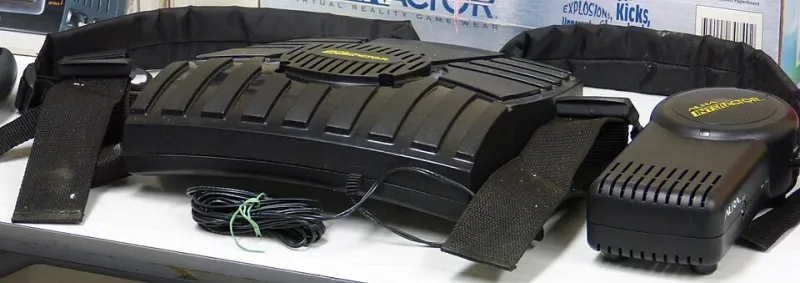
Photo: Gazebo, CC BY-SA 4.0, via Wikimedia Commons
For years, the pitch for haptics went like this: put on a vest, feel the explosion, take it off, tell a friend. It was a demo, not a habit. Somewhere between 2024 and now, that changed — not because the technology got dramatically better, but because enough of it got cheap, quiet and small enough to leave plugged in. The haptic home is real in 2026. It's just messier, noisier and more cramped than the launch videos suggest.
Walk into any big electricals retailer this month and you'll find force-feedback wheels, haptic vests, seat transducers and a small pile of gloves that nobody has calibrated since the store opened. The question for a UK buyer isn't whether touch feedback exists at consumer prices. It's whether any of it survives contact with an actual living room.
The kit that's actually shipping
Three rough families of product have settled in.
Wearables. Vests and belts using linear resonant actuators or small eccentric rotating masses are now the cheapest way to feel anything on your torso. They're lightweight, they run off USB power, and the good ones let you dial intensity down to something a shared household can tolerate. Gloves remain the weak link — tracking is fine, but per-finger feedback is still fiddly, sweaty and expensive, and most people I speak to use theirs twice and then put it in a drawer next to the exercise bike.
Furniture-adjacent. Seat pads and under-cushion transducers have quietly become the most-used haptic purchase in UK homes, mostly because they double as a bass shaker for films. They're simple, they're cheap, and they don't require you to strap anything to your body. The catch is that they transmit through floors with enthusiasm.
Controllers and peripherals. Handheld haptics are the least glamorous and the most reliable. Good triggers with variable resistance do more for immersion in a racing or simulation title than a vest ever will, and they cost a fraction as much. Mice and trackballs with force feedback have crept into remote-work setups too, mainly as a way of making drag-and-drop and boundary collisions feel like something.
What a British living room does to haptics
The average UK home is not a California garage conversion. It's a Victorian terrace with a chimney breast in the wrong place, or a 1990s new-build where the 'dining area' is 2.4 metres from the telly. That geometry matters more than spec sheets admit.
Space and sightlines. Room-scale VR is a luxury. Most people are seated or standing in a footprint smaller than a snooker table, which means anything with a cable is a trip hazard and anything with a strap needs to go on and off in a hurry. Haptic gear that requires a dedicated chair, a rig or a fixed base station is essentially asking for a spare bedroom.
Sound leaking next door. Party walls are thin. A transducer bolted to a sofa frame will happily introduce your flatmate — or the family in the semi next door — to the low-frequency contents of your evening. Vibration isolation pads are not optional in flats. If the product doesn't mention decoupling, assume you'll be buying foam yourself.
Heat, dust and radiators. Controllers and vests live near radiators, in rooms where a fan heater gets switched on in February. Nothing kills a haptic actuator faster than running at full intensity in a warm room with lint in the vents. Long sessions on a sofa also mean fabric — the one part nobody tests. Washable, replaceable liners should be table stakes and mostly aren't.
Power and cabling. UK living rooms have a fixed number of double sockets behind the telly and a nest of extension leads behind that. Anything drawing serious current or needing three separate USB bricks is going to lose that argument with the household.
The price problem nobody says out loud
Sterling pricing in 2026 is better than it was, but haptics still carries a novelty premium. A decent vest costs about the same as a mid-range console. Gloves cost more. And unlike a headset, none of it improves over time without developer support — which is patchy. When a game ships with haptic profiles tuned for one brand, everyone else gets a generic rumble and a shrug.
There's also the post-Brexit reality of buying from overseas: import handling, VAT, returns that involve a courier form and a fortnight of waiting. That risk sits disproportionately on the small, interesting manufacturers — the ones making the genuinely novel stuff — rather than the big brands with UK distribution. It quietly narrows what British buyers will try.
What to look for in 2026
- Latency under roughly 20ms. Anything slower feels like a notification, not a sensation.
- An honest intensity dial. If the lowest setting is still a jolt, the product was designed for a demo booth.
- Open SDK and documented Bluetooth or USB-C protocol. You want the option to fix things yourself.
- Replaceable, washable interfaces. Straps and liners meet skin and sweat.
- Decoupling in the box. Foam pads, rubber feet, anything that keeps the vibration out of the building.
- A UK returns address. Non-negotiable for anything over a hundred quid.
The honest summary: buy haptics the way you'd buy a good office chair. Not for the demo, but for the Tuesday evening when you've forgotten it's there and it's quietly making something better. That's the test the category still has to pass — and in 2026, a handful of devices are finally passing it.