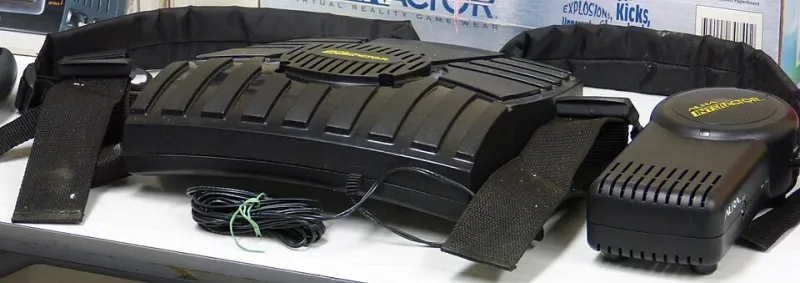
From Classroom to Control Room: Six Haptic Accessories Trying to Earn a Place in Everyday VR

Photo: John desosa, CC BY-SA 4.0, via Wikimedia Commons
Haptic gloves dominate the coverage, and they are almost never the right purchase for a shared training room. They take time to don, they vary wildly in fit, they get warm, and they present a hygiene question that nobody in procurement wants to answer on a Monday morning.
The interesting work is happening everywhere else on the body. Vests, wristbands, desk pads, seat units and retrofitted controllers are all chasing the same goal: haptics that survive being used by twelve different people in one afternoon. Here are six categories worth watching, framed by the only question that really matters. Not "how does it feel in a demo?" but "would this still be working in March?"
Why "beyond the glove" is the right brief
The maths is simple. If donning takes ninety seconds and a session is twenty minutes, you have lost seven per cent of your training budget to velcro. If the kit needs a dedicated operator, you have lost a member of staff. If it can't be wiped down between users, you have lost the room.
Shared-space VR has different requirements from home VR: fast fitting, adjustable sizing across a wide range, cleanable surfaces, and a story for what happens when someone drops it. Anything that clears those hurdles is worth a look regardless of how impressive the fidelity numbers are.
1. The haptic waistcoat
Torso cueing is the most underrated trick in the toolbox. Because it doesn't compete with your hands, it can deliver continuous information: the rumble of a machine you're meant to be operating, the direction of an alarm, the moment a virtual load shifts. In industrial and rail training it's often more useful than anything at finger level.
Readiness: decent, with caveats. The main issues are heat, weight distribution and sizing across a real workforce rather than a demo team.
Test before you buy: the washable liner, the weight after forty minutes, and whether the actuators are quiet enough that a room of eight users doesn't sound like a hive.
2. The wristband
Low fidelity, low cost, high practicality. A band can't tell you the texture of a surface, but it can tell you that you have crossed a threshold, that a colleague has entered your space, or that a procedure step is complete. As an alerting channel it's excellent, and it's the one piece of kit here that a first-time user can put on without help.
Readiness: good, with a caveat about differentiation. Three distinct patterns are learnable. Seven are not.
Test before you buy: latency, and whether users can distinguish patterns while also listening to an instructor.
3. The desk-mounted touch pad
For seated work, a small unit on the desk beats anything strapped to you. Design reviews, surgical planning, CAD walkthroughs and museum collection handling all happen at a desk, and all benefit from feeling a surface resist or a button click under a fingertip.
Readiness: variable. Ultrasonic approaches, of the sort pioneered by Bristol's Ultraleap, are silent but sensitive to hand position. Pin-array and mechanical pads give firmer feedback but whine audibly, which matters in a quiet office.
Test before you buy: noise levels in a silent room, desk clamping, and how the surface copes with being cleaned between users.
4. The seat unit
Haptics in the chair is the sleeper category. Transducers in a seat pan can suggest engine vibration, track rumble or a collision, and they do it without asking the user to wear anything at all. For driver and plant simulators this is close to a no-brainer.
Readiness: strong for fixed installations, weak for anything that has to move between rooms.
Test before you buy: cabling routes, whether it works with the office chairs you already own, and whether the effect is legible rather than just buzzy.
5. The fingertip retrofit
A middle path between a full glove and nothing: a liner, thimble or clip that adds a small amount of feedback to one or two fingers. You lose fidelity, you gain speed, and you keep the hygiene conversation manageable because the unit is small and wipeable.
Readiness: early. Sizing ranges are still narrow and comfort over an hour is unproven for most options.
Test before you buy: whether it stays put during fine manipulation, and how it behaves when hands get warm.
6. The controller with haptic triggers
The least exciting entry, and probably the one that survives. Controllers already fit the shared-space model: robust, quick to hand over, easy to clean. Adding resistance or feedback to the trigger gives you a surprising amount of information about pressure, torque and material, which is exactly what procedural training needs.
Readiness: the strongest of the six for real deployments.
Test before you buy: swappable batteries rather than sealed cells, drop ratings, and whether it's tied to one headset ecosystem or speaks OpenXR properly. UK-based teams in this space, including the Welsh-founded Teslasuit crowd and the wider XR integrator scene, tend to be pragmatic about this, but lock-in is still a commercial choice you should make deliberately.
The procurement checklist
Before any of the above goes on a purchase order, run these five tests.
- The stranger test. Hand it to someone who has never seen it and time how long they take to get it on. If it's over a minute, multiply that across your annual sessions.
- The rotation test. Twenty users in a day. Where does the grime go, and what do you clean it with?
- The latency test. Ask for numbers under load, not in an empty room with a demo build.
- The spares test. Can you get a replacement strap, liner or actuator in the UK within a fortnight, and what does the warranty actually cover?
- The access test. One-handed fitting, adjustable across a real range of body types, and a documented story for users with reduced sensation in the hands.
The verdict
Rank the six by how likely they are to be in the cupboard, still working, next winter, and the order changes. The band and the controller win on robustness. The waistcoat wins on usefulness where the simulation genuinely involves the body. The desk pad wins wherever the work is seated and the room is quiet.
Haptics in VR stop being a novelty the moment the kit stops being precious. Design for the twelfth user of the day, not the first, and the technology starts to look less like a gadget and more like equipment.