Waving at Nothing: What a British Washroom Taught Me About Haptic Trust
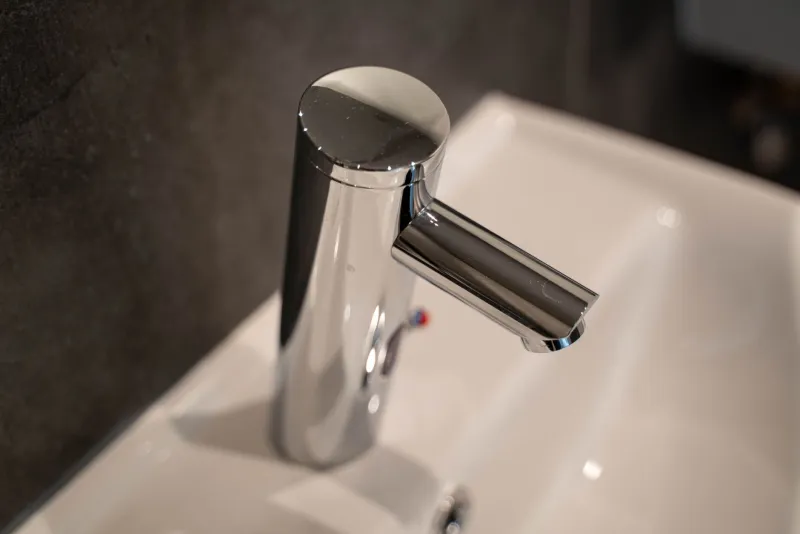
There is a particular kind of loneliness to standing at a sensor tap in a motorway services off the M6, waving your hands underneath it like you're performing a small, sad magic trick for an audience of nobody. The water comes, or it doesn't. You try again, slightly higher. Then slightly lower. Then you touch the tap itself, which feels like cheating, and it turns out the tap is not a button and never was, and you are now a grown adult negotiating with a chrome tap at half nine in the morning.
I've been thinking about that tap a lot lately, mostly because I've spent the past few months watching people try on haptic kit and then quietly take it off again. The failure modes rhyme. The washroom and the headset have the same problem: both ask a human hand to believe something without giving it enough to go on.
The tap that wants you to guess
A sensor tap is an interface with no visible affordance. Nothing about the object tells you where the interactive zone is, how long it stays live, or what counts as a valid input. You learn the rules by breaking them repeatedly and being ignored. Designers sometimes call this "discoverability". In a washroom in Britain on a wet Tuesday, it's closer to a personality test.
The interesting thing isn't that it fails. It's that it fails so often that we've all built folklore around it — the hand hovering two centimetres higher, the little sideways shimmy, the guy in the next basin who clearly knows the trick and is not sharing. Users who invent rituals are users who have given up on the object explaining itself.
Haptic VR does this constantly. A controller gives you a pulse somewhere near your palm and expects you to infer that you've grabbed, or hovered, or triggered, or been rejected. If your testers start performing ritual gestures to make the interaction work, that's not a quirk of your user base. That's a design note.
Late dryers and the confirmation gap
The hand dryer is worse, because it adds time. You put your hands in. Nothing. You put them in further, at an angle, like you're posting a letter. Then — just as you've given up and started drying your hands on your jeans, which is the British national sport — it roars into life and blasts your thighs.
What the dryer is doing is failing a confirmation test. In haptics we talk endlessly about fidelity: how convincing the buzz is, whether the grain of a virtual surface reads as wood or metal. But the thing that actually decides whether someone trusts a system is whether the system acknowledges them promptly and unambiguously. A mediocre vibration delivered instantly will feel more real than a beautiful one delivered 400 milliseconds after the fact. The dryer gets this backwards. It has enormous power and no sense of timing, which is a description that could also apply to a depressing number of VR demos.
Latency isn't a technical footnote. It's the difference between a hand that feels present and a hand that feels like it's being operated by someone in another room.
The lock with two opinions
And then there's the cubicle door. Is that slot red because it's occupied, or because it's unlocked? Is the handle meant to be turned, slid, or lifted? Does the little pictogram of a person mean "engaged" or "this is a door"? Nobody knows. The lock has a state, but the state is communicated in a dialect you don't speak.
Ambiguous state is the quiet killer of immersive interfaces. In VR it shows up whenever a system is doing something on your behalf — recentring, loading, recalibrating, tracking your hands, losing your hands — and doesn't tell you which. Your user isn't confused in an abstract way; they're confused in their body. They hold still because they don't know what movement will break.
Good washroom design (and it does exist, in the newer ones, with the clear green tick and the unambiguous push bar) treats state as something you broadcast, not something you infer.
What a washroom understands that a demo doesn't
Here's the argument I keep landing on: these are low-stakes, high-friction encounters, and that combination is exactly what makes them a better design school than any showroom floor. Nobody is impressed by a public loo. There's no brand team in the room. All that's left is whether the thing responded to a human hand in a way the human could understand.
Three lessons worth pinching for haptic work:
Be generous with the input window. If a user's hand is in roughly the right place, treat that as intent. Haptic interactions should forgive a centimetre of sloppiness, because real hands are sloppy and asking people to be precise for no reason reads as hostility.
Acknowledge before you deliver. A tiny confirmation tick the moment input is registered buys you patience for whatever heavier rendering comes after. The dryer that says "I see you" before it says "here's the hurricane" would be a better dryer.
Make the state visible in a way that doesn't require a manual. If your hand is tracked, the virtual hand should be doing something. If it isn't tracked, stop pretending. Silence and ambiguity are not the same neutrality; one of them is a lie.
The wiped hand test
There's a moment in every washroom visit where you decide whether the building is on your side. It comes when you've given up on the dryer and gone for the jeans, and you glance back at the machine, still blowing at nothing, still confident, still utterly unaware you left. That's the feeling I want designers to hold onto when they're tuning a grab interaction: the specific, small indignity of being ignored by something that was built to serve you.
We're at a point in the UK where haptic accessories are finally cheap enough and good enough to reach living rooms and classrooms and museum floors, and the difference between the ones that stick and the ones that end up in a drawer will not be their motors. It'll be whether they noticed you were there. The British public loo, for all its faults, has spent decades teaching us precisely what that failure feels like — and, occasionally, on a good day, at a nice new services on the M40, exactly what getting it right feels like too.