Before Your Hand Moves: What British Door Furniture Knows About Haptic VR

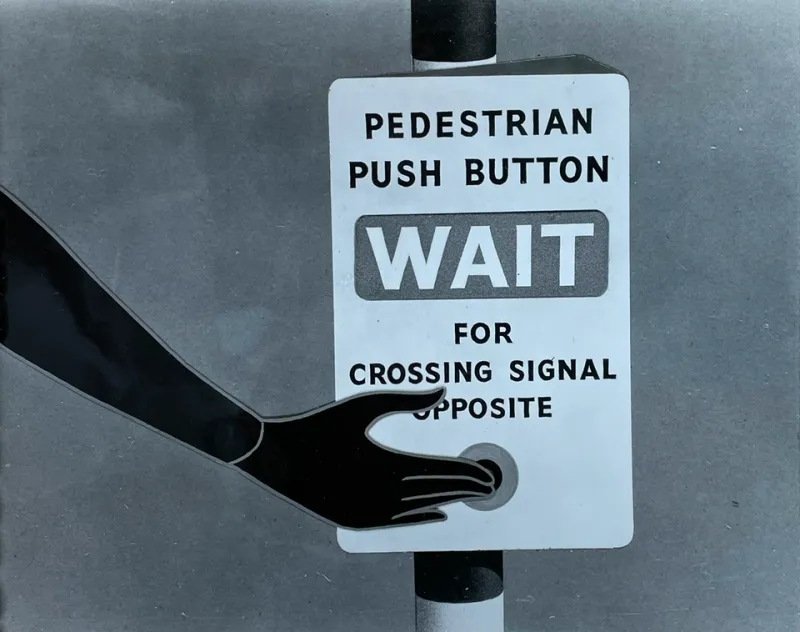
Photo: Bill Nicholls , CC BY-SA 2.0, via Wikimedia Commons
There is a quiet moment before you touch a door. You have already read the thing. The shape of the handle, the height of the bar, the stiffness of the latch, the little brass plate that says PUSH — all of it lands before your fingers do. A British door is not just an opening. It is a pre-movement briefing.
That is the bit haptic VR keeps skipping. We build beautiful virtual rooms, then stick a floating label on the handle or run a tutorial prompt that says “grip to open.” The door itself should have told us. In the physical world, it usually does.
The door as a pre-flight check
Think about the last door you used without thinking. Maybe it was a Victorian terraced house with a heavy brass knob, the kind that feels cold in winter and slightly loose in summer. Maybe it was a pub door with a thumb latch that clicks before it swings. Maybe it was an office fire door with a horizontal bar that asks for your whole forearm, not a dainty fingertip.
Each of those designs is doing affordance work. It is telling you how to hold it, which direction to move, how much effort to expect and whether you are allowed through. No label required. The hardware has already made its case.
Haptic VR has the same opportunity, but it tends to treat resistance as decoration. A controller buzzes when you touch a handle, then the virtual door swings open with a smooth animation. That is not affordance. That is a sound effect with a grip trigger attached.
Brass, thumb latches and the grammar of permission
British door furniture is a useful study because it is so varied. A polished brass knob on a Georgian townhouse says “turn me, but mind the weight.” A thumb latch on a cottage door says “press here, then push.” A long bar on a fire door says “use your body, not your hand.” An accessible lever handle says “this should be easy, and it should stay easy.”
Those are not just shapes. They are instructions written in metal and timber. The best ones are almost rude in their clarity. They do not care whether you have used this door before. They tell you anyway.
In VR, a haptic controller can mimic some of that grammar. A knob could offer rotational resistance that builds as you turn, then releases with a soft detent. A thumb latch could require a small inward press before the grip axis unlocks. A fire door bar could demand a broader, faster movement — a shove rather than a twist. The point is not realism for its own sake. The point is that the hand should know what it is doing before the brain starts reading prompts.
Fire doors and the honest push bar
Fire doors are the unsung heroes of affordance. A push bar is big, obvious and difficult to misread. It sits at forearm height, runs most of the door’s width and asks for a movement that is almost impossible to do delicately. You do not turn it. You do not pull it toward you. You lean in and push.
That kind of honesty is useful in VR because it removes ambiguity. If a virtual door needs to open outward in a panic, the haptic design should feel like a push bar, not a mysterious brass disc. The controller should meet your hand with a flat, broad resistance and then give way in one direction. No floating arrow. No glowing outline. Just a physical sentence: this way, with this much force, right now.
British fire doors also carry a social cue. They are heavy because they are meant to close themselves. They are not inviting you to linger. Haptic VR can use that weight to communicate consequence. A door that feels light and tappy in the hand reads as decorative. A door that pushes back reads as real.
Lever handles, access and the cost of guessing
Accessible lever handles are a good reminder that affordance is not only about direction. It is about who gets to move comfortably. A well-designed lever can be operated with a closed fist, an elbow or a wrist that does not rotate easily. It does not demand a precise pinch. It does not punish you for arriving with your hands full.
VR has a bad habit of designing for the default hand. It assumes a certain grip, a certain range of motion, a certain confidence with controllers. Then it papers over the gaps with tutorials. A better approach is to let the virtual hardware do more of the work. If a handle is meant to be easy, its haptic profile should be forgiving — low initial resistance, a clear opening path, no sudden jolt. If it is meant to be stiff, the stiffness should be legible rather than surprising.
The difference matters because guessing is tiring. In the physical world, a bad door makes you look foolish for half a second. In VR, a bad door can make you feel like you have failed at the interface. That is a design problem, not a user problem.
Building resistance into the virtual handle
So what does this look like in practice? It starts with deciding what the door is saying before the hand arrives. Is this a gentle domestic door, a secure service door, a public entrance, a fire exit? The haptic profile should follow that decision, not contradict it.
A few practical cues are worth testing. Rotational resistance on a knob can signal “turn.” A short inward click before a pull can signal “release the latch.” A broad, low-frequency rumble on a push bar can signal “body weight.” A lever that moves easily but stops firmly at the end can signal “accessible, but not loose.” These are small things, but they add up to a door that feels like it has a point of view.
None of this replaces good visual design. It simply stops the visuals from doing all the talking. A virtual handle should not need a caption to explain its personality. The controller should tell you whether you are about to turn, press, pull or shove.
What to test before shipping
Before a virtual door goes into a build, try it with the labels switched off. Ask someone to approach it cold. Watch where their hand goes first. If they hesitate, the affordance is weak. If they try to pull a push door, the haptic grammar is wrong. If they need a tutorial prompt to find the latch, the handle has failed its first job.
British doors are not perfect. Plenty of them are awkward, heavy and badly labelled. But the good ones have a lesson for haptic VR: the handle should already have told you. By the time your fingers close, the conversation should be halfway done.