Checkout Blues: Can a Buzz Really Shrink a British Supermarket Queue?
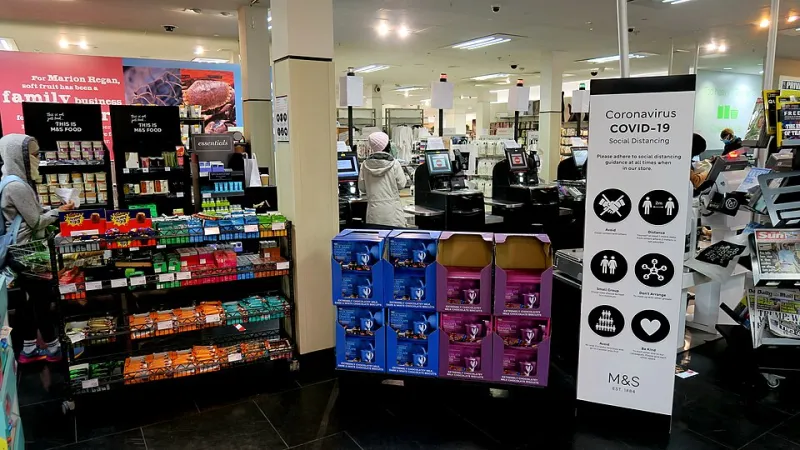
Photo: Kwh1050, CC BY-SA 4.0, via Wikimedia Commons
The self-checkout at a Tesco Express on a wet Tuesday has become a small theatre of British frustration. You scan a meal deal. The machine pauses. A recorded voice says something about an unexpected item in the bagging area. The queue behind you does that very British thing of pretending not to sigh. Somewhere between the barcode and the bag, shopping has lost its clunk, its weight, its little physical confirmations. Now a handful of UK trials are asking whether touch can fill that gap.
The checkout has a feeling problem
Self-checkouts, scan-and-go apps and contactless payment have made grocery shopping quicker in one sense and stranger in another. The transaction happens through glass, beeps and green lights. A scan is confirmed by a sound you might not hear in a busy store, or a visual tick you might not see if you are looking at your bag. For most shoppers this is background noise. For others it is a genuine barrier.
The haptic answer sounds simple: add a small pulse when an item is recognised, a different pattern when something goes wrong, and a clear tactile cue when payment has gone through. In practice, the details matter. A buzz that arrives a second late is worse than no buzz at all. A pattern that feels obvious in a lab can be lost through a coat sleeve or a winter glove. And a checkout that vibrates for every minor event quickly becomes another layer of noise in an already noisy environment.
What the quiet trials are doing
The big UK grocers have spent the past few years pushing self-checkout and scan-and-go in different forms. Some are now testing haptic feedback in handheld scanners, companion apps and card readers. The trials are small and patchy, not a national rollout. But the pattern is consistent: use touch to answer the question shoppers ask silently at the till. Did that scan? Has the payment gone through? Is the machine waiting for me?
That is a narrower brief than it first appears. Haptics work best when they replace ambiguity, not when they duplicate every beep and flash. A short double pulse for a successful scan, a longer low-frequency buzz for an error, and a distinct final pattern for payment are the sort of cues being trialled. The good versions are adjustable. The bad versions assume every shopper has the same sensitivity, the same hand size and the same tolerance for being quietly vibrated in public.
Queue anxiety is not a vibration problem
Here is the sceptical case. Queue anxiety in a British supermarket is rarely caused by a lack of tactile feedback. It is caused by uncertainty, social pressure and the feeling that everyone behind you is judging your packing technique. A haptic cue can help if it removes a fraction of that uncertainty — if you no longer have to wait for the screen to catch up, or lean in to hear a till over the chatter. But it cannot fix a badly laid out checkout, a shortage of staff, or a system that flags every third item for no clear reason.
There is also the risk of haptic overload. If the scanner pulses, the phone buzzes, the card reader vibrates and the screen animates, the shopper learns to ignore all of it. Touch is a quiet channel. It loses its power when it is used as decoration. The strongest trials are likely to be the ones that use fewer cues, not more, and make each one mean something specific.
The accessibility case is stronger than the convenience case
The most persuasive argument for haptic checkout is not speed. It is access. Checkout feedback has long leaned on sound and vision: a beep, a green tick, a small line of text. That excludes or disadvantages people who are deaf or hard of hearing, people with low vision, and some neurodivergent shoppers who find busy audio-visual environments draining. A well-designed tactile cue can give the same information through a channel that is private, immediate and less dependent on the surrounding noise.
But accessibility is not a single pattern. Some people will want a strong confirmation; others will want something barely there. Some will want error cues to be discreet; others will need them to be unmistakable. Charities such as RNIB and Sense have argued for years that inclusive design is about choice, not a universal solution. Haptic checkout should follow the same logic. Let shoppers adjust intensity. Let them turn cues on or off. Train staff to explain what the patterns mean. And do not remove the human option for people who need it.
What would make it work
The useful version of haptic checkout looks less like a gadget and more like a shared language. Cues should be consistent across stores and devices, so shoppers are not learning a new vocabulary at every till. They should be short, distinct and tied to a clear action. They should work through gloves, pockets and reusable bags. They should never be the only feedback channel, and they should never replace the staff member who can actually solve the problem.
If that sounds unglamorous, it is. The checkout does not need to be exciting. It needs to be legible. A small buzz that says yes, that scanned is not a gimmick if it saves someone from leaning towards a screen they cannot read. A low pulse that says wait, the machine needs you is not a gimmick if it stops a shopper walking away mid-transaction. But a haptic system that simply adds another layer of confusion will be treated the way British shoppers treat most unnecessary technology: politely ignored, then bypassed at the first opportunity.
The trials are worth watching. Just do not expect touch alone to shrink the queue. The best it can do is make the waiting feel a little less uncertain.