The National Clunk: What Contactless Britain Can Teach VR Haptics

Photo: Metropolitan Transportation Authority from United States of America, CC BY 2.0, via Wikimedia Commons
The first time I tapped a bank card on a TfL reader, I did not think about haptics. I thought about whether the gate would open. But the gate did open, with that unmistakable mechanical clunk, and my brain filed the moment away as a tiny contract: I pressed, it responded, I can proceed.
Britain is now a country of small tactile contracts. We tap cards on buses, phones on readers, self-checkout screens at Tesco, door-entry buzzers in flats, and contactless pads outside offices. Most of these interactions are visually dull. What makes them work is the confirmation — the beep, the click, the brief vibration, the release of a magnetic lock. We have trained ourselves to expect instant physical proof that something happened.
VR haptics should be learning from that national behaviour. Not by copying the beep, but by understanding the role it plays.
The tap is a contract
Contactless payment works because it reduces a complex transaction to a gesture and a response. The gesture is almost trivial: a wave, a press, a tap. The response is what carries the trust. Without the beep, you would hover your card again. Without the clunk, you would push the door twice. The feedback is not decoration. It is the punctuation that tells you the sentence is over.
In VR, we often treat haptics as spectacle. Controllers buzz when a sword hits a shield, when a car engine revs, when a virtual hand brushes grass. That can be fun. But the everyday magic of contactless life is more useful: it shows how a tiny, consistent cue can make an interaction feel finished.
A menu selection in VR should have that same certainty. A grab should feel like a grab, not a vague wobble. A button press should land with a crisp tick, not a mushy rumble. The user should never have to wonder whether the system heard them.
What VR gets wrong
Too many VR experiences use haptics as volume rather than vocabulary. Everything buzzes. The controller trembles when you look at an object, when you approach a door, when a character speaks, when the music swells. After five minutes, the user has no idea which vibration meant ‘you can interact with this’ and which meant ‘something dramatic is happening off-screen’.
Contactless Britain is not like that. The self-checkout beep is different from the door-entry buzz. The TfL gate clunk is different from the phone’s payment confirmation. We learn those differences without ever being taught. That is the standard VR haptics should aim for: a small set of reliable cues, used consistently, so the user can stop thinking about the interface and get on with the experience.
Copy the clunk, not the noise
The useful lesson is not ‘make everything buzz’. It is ‘make confirmation feel inevitable’. A short pulse at the point of contact. A tiny detent when a slider clicks into place. A low thrum when a boundary is reached. These are the haptic equivalents of the green light on a card reader: modest, repeatable, and deeply reassuring.
There is also a lesson about latency. Contactless payments feel instant because they mostly are. If the reader took two seconds to beep, we would lose confidence. VR has the same threshold. Feedback that arrives late feels like a glitch, not a confirmation. Designers should treat a missed haptic cue the same way they would treat a dropped frame.
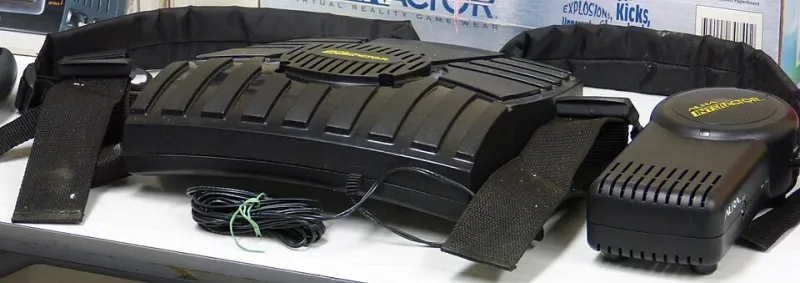
And there is a lesson about placement. The buzz on a phone is felt in the hand; the clunk of a door is felt through the whole arm. VR can use that distinction. A controller pulse can say ‘selected’; a haptic vest or wristband can say ‘you are close to something’. The point is not realism for its own sake. It is clarity.
Where to break the pattern
Here is where I part company with the ‘make it like contactless’ argument. Familiarity is useful for confirmation, but it is terrible for wonder. If every VR interaction feels like a self-checkout, the medium becomes a very expensive payment terminal.
Designers should deliberately break the contactless pattern when the moment calls for it. A warning should not feel like a successful tap. A boundary in a virtual space should feel firmer, slower, more deliberate. An emotional beat — a hand on a shoulder, a change in weather, a character’s presence — can use a longer, softer texture that would be useless at a till but perfect in a story.
The mistake would be to make all haptics either purely functional or purely theatrical. Britain’s contactless habit works because it is functional and almost invisible. VR needs that base layer. But it also needs moments where touch stops being a receipt and becomes a sentence.
A haptic language for impatient people
We are, as a nation, politely impatient. We expect the gate to open, the screen to accept, the door to release. We do not want to learn a new language every time we pay for a coffee. VR designers should respect that impatience. Give users a small, consistent set of tactile cues they can learn in seconds. Then spend your creativity on the moments where surprise is welcome.
The contactless clunk is not glamorous. It is not immersive. But it is trusted. And trust is the thing VR haptics needs most.